Current Project / Proyecto Actual

Everyday Atlas is an artistic research project that proposes an alternative form of mapping based not on coordinates, but on relationships.
It asks: what remains invisible when a place is mapped?
Contemporary places are increasingly represented through digital maps, satellite imagery, geolocation systems, and algorithmic interfaces. While powerful, these tools tend to prioritize location, geometry, and visibility. They rarely capture the everyday experiences through which places acquire meaning—the object used daily, a gesture repeated over years, the sounds of a workshop, the commute to work, the history attached to a piece of clothing, or the memories embedded within a domestic space.
My project is rooted in the idea that an everyday object can serve as an entry point into a place. A chair, a tool, a garment, a kitchen utensil, a piece of work equipment, or any other common object may hold traces of use, repair, migration, labor, affection, and transformation. I do not intend to collect objects as if they were ethnographic specimens; rather, I treat them as catalysts for artistic encounters—material clues through which we can reconstruct the relationships between people, spaces, and ways of inhabiting the world.
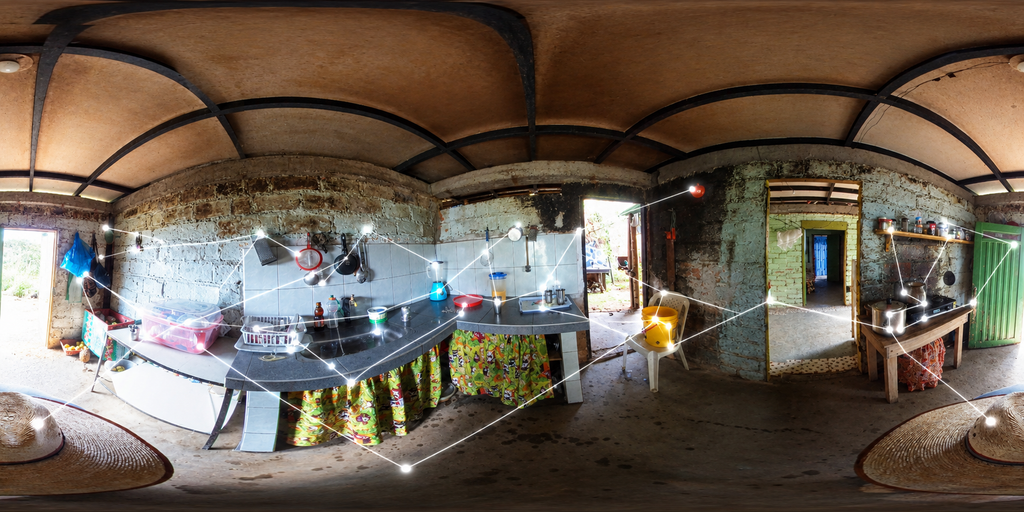
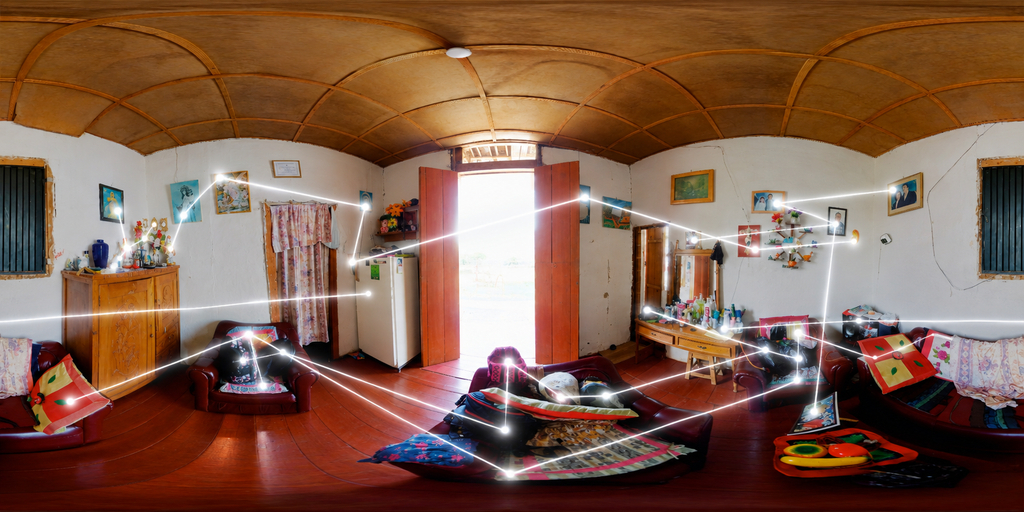
The core artistic unit of this project is the «relational constellation.» Each constellation connects an object to a person or a story, a specific location, images, sounds, and a spatial interpretation. Instead of producing a conventional photographic series, I will construct a network of partial perspectives. A place is understood through its surroundings, what is remembered within it, what is heard there, and what an object allows us to uncover.
The project integrates photography, 360° imagery, drawing, sound recording, short narratives, and digital cartography. These media are not independent outcomes, but rather different ways of approaching the same subject. Photography allows me to isolate specific details and traces. 360° imagery expands the field of vision, challenging the conventions of traditional photographic framing. Sound introduces dimensions of a place that remain invisible to the eye. Drawing allows me to reconstruct, interpret, or imagine aspects that photography cannot fully encompass. Narrative places personal experience in dialogue with visual evidence, while cartography connects the resulting fragments without reducing them to mere coordinates.
In this sense, the 360° image is conceptually significant. Conventional photography creates meaning through selection—what is included within the frame versus what is left out. A spherical image alters this dynamic by enveloping the viewer within the environment. I aim to investigate whether removing the boundaries of the frame can reveal the network of spatial and social relationships that imbue an object with meaning. Immersion is not the subject of the project, but rather a method for questioning how a place is represented.
The project is intended to be implemented within a new geographical and cultural context for this research. My approach will center on walking, observation, photographic encounters, and the creation of imagery rooted in the territory. I will focus on everyday settings rather than iconic landmarks—domestic spaces, workshops, markets, streets, small businesses, workplaces, transit routes, and locations shaped by daily routines. The selection of objects and stories will remain fluid during the initial phase of the residency, allowing these encounters to shape the direction of the research.
This is not a singular, homogeneous territory, but rather a network of movements, exchanges, memories, and cultural intersections. Certain places offer an opportunity to examine how everyday material culture reflects these layered histories, without reducing them to a monolithic narrative of identity. My perspective is informed by my background in Colombia, where my artistic practice has consistently explored everyday objects, territory, urban experience, cartography, and immersive representation. Working in this new setting will allow me to test and transform the methods I developed within a Latin American context, adapting them to a different social and geographical environment.
The research will unfold in four stages.
- 1. LISTENING TO PLACE :The first stage will focus on walking, observation, mapping and encounters. I will identify possible sites, objects and stories while documenting the sensory and spatial characteristics of the places where they emerge. This stage is intentionally exploratory: the research will be guided by encounters rather than by a predetermined catalogue.
- 2. OBJECTS AND ENCOUNTERS: The second stage will develop a selection of approximately ten to twelve relational constellations. Through conversations and situated observation, I will explore the stories, gestures and forms of use associated with each object. The aim is not to produce exhaustive interviews, but concise narratives that reveal relationships between material things and lived experience.
- 3. EXPANDED REPRESENTATION: The third stage will translate these encounters into photographs, 360° images, drawings and sound recordings. I will experiment with how these media can be combined, contrasted or layered. Particular attention will be given to the relationship between the conventional photographic frame and the expanded spatial field of 360° imaging.
- 4. ATLAS / CONSTELLATION: The final stage will connect the fragments into an evolving artistic atlas. I will develop a spatial and/or digital presentation in which viewers can move between objects, places, voices, images and sounds. The result will not be a closed geographic map, but an atlas of relationships: a structure through which different experiences of place can coexist.
The project is relevant today because mapping technologies increasingly shape how people understand and navigate their environments. At the same time, algorithmic images and digital platforms tend to flatten complex lived experiences into points, routes and searchable views. Everyday Atlas proposes an artistic counter-map: one that does not reject technology, but uses it critically to recover what technological representations often leave aside.
The outcome of a possible residency will be a new body of interdisciplinary artistic research consisting of relational constellations combining objects, photographs, 360° environments, drawings, sounds and narratives, together with a prototype for an expanded atlas. More importantly, allow me to consolidate a methodology that can continue beyond Provence and be applied to other territories.
Everyday Atlas is therefore conceived not as the documentation of a place, but as an experiment in how places become meaningful. It asks whether an object can become a map, whether a story can become a coordinate, and whether an expanded image can reveal forms of everyday life that conventional maps cannot contain.